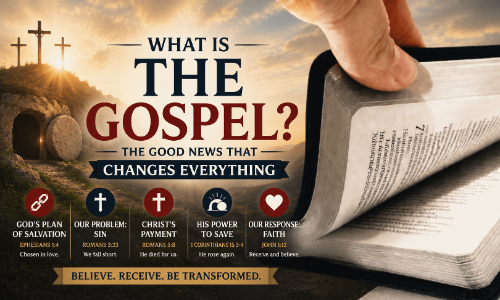
What Is the Gospel? Understanding the Good News of Jesus Christ
Introduction
Many people assume Christianity begins with a command.
“Try harder.”
“Be a better person.”
“Fix your life.”
But the message of Christianity does not begin with advice. It begins with an announcement.
The Bible calls this announcement the Gospel—the good news of what God has done through Jesus Christ.
In 1 Corinthians 15:1–4, the Apostle Paul reminds believers of the message that stands at the center of the Christian faith:
“Moreover, brethren, I declare unto you the gospel which I preached unto you… by which also you are saved… that Christ died for our sins according to the Scriptures, and that He was buried, and that He rose again the third day.”
The Gospel is not a philosophy, a moral code, or a program for self-improvement. It is the proclamation that Jesus Christ accomplished salvation through His death and resurrection.
And here is something vital for every Christian to understand: you never move beyond the Gospel—you only grow deeper into it.
To understand Christianity rightly, we must first answer one essential question:
What is the Gospel?
The Gospel Is News, Not Advice
When Paul writes in 1 Corinthians 15:1–2, he says:
“I declare unto you the gospel which I preached unto you…”
The word gospel literally means good news.
And news is fundamentally different from advice.
Advice tells you something you must do.
News tells you something that has already happened.
Advice says:
- Improve yourself
- Change your life
- Do better
But news says:
- Something has occurred
- Something has been accomplished
The message of Christianity is not primarily about human effort. It is about divine accomplishment.
Sadly, many sermons today focus mostly on life improvement:
- How to succeed
- How to overcome obstacles
- How to reach your potential
While practical wisdom can be helpful, it is not the heart of the Christian message.
The Gospel is not a collection of motivational tips.
The Gospel is a declaration about Jesus Christ.
It tells us what God has done in history to save sinners.
The Content of the Gospel
Paul summarizes the Gospel in 1 Corinthians 15:3–4 with remarkable clarity:
“Christ died for our sins according to the Scriptures… He was buried… and He rose again the third day.”
The Gospel rests on three historical events.
- Christ died
- Christ was buried
- Christ rose again
Notice what Paul emphasizes.
He does not say:
- We prayed
- We fasted
- We obeyed
Instead, he focuses entirely on what Christ has done.
Christianity is built on the finished work of Jesus, not on human achievement.
The most important phrase in this passage is:
“Christ died for our sins.”
This tells us why the cross was necessary.
Sin is not merely a list of bad behaviors. At its core, sin is a condition of separation from God. Humanity stands guilty before a holy God.
But God did not ignore sin.
He dealt with it through substitution.
The prophet Isaiah foretold this centuries earlier:
“All we like sheep have gone astray… and the Lord has laid on Him the iniquity of us all.” — Isaiah 53:6
At the cross, Jesus Christ stood in the place of sinners.
He bore the judgment that we deserved.
This is the heart of the Gospel.
The Gospel Is Christ-Centered, Not Man-Centered
The subject of the Gospel is not human potential.
It is Jesus Christ and His saving work.
After His resurrection, Jesus explained this truth to His disciples. In Luke 24:27, we read:
“Beginning at Moses and all the prophets, He expounded unto them in all the Scriptures the things concerning Himself.”
This means the entire Bible ultimately points to Christ.
The Bible is not primarily about:
- David’s courage
- Joseph’s discipline
- Daniel’s prayer life
Those stories can inspire us, but they are not the main message.
The Scriptures reveal God’s plan of redemption fulfilled in Jesus Christ.
When preaching or teaching removes Christ and replaces Him with moral principles, the message of the Gospel disappears.
Christianity is not about becoming the hero of your own story.
It is about the true Hero—Jesus Christ—who saves sinners through His grace.
The Gospel Deals With Sin Completely
One of the most powerful explanations of the Gospel appears in 2 Corinthians 5:21:
“For He made Him who knew no sin to be sin for us, that we might become the righteousness of God in Him.”
This verse reveals a profound exchange.
At the cross:
- Our sin was placed on Christ
- God’s judgment fell on Christ
- Christ’s righteousness is given to us
This means the believer’s relationship with God is not based on personal performance but on Christ’s completed work.
Because Jesus bore our judgment, God is no longer counting the believer’s sins against them.
That is why the Apostle Paul can say in Romans 8:1:
“There is therefore now no condemnation to those who are in Christ Jesus.”
The freedom of the Gospel comes from this truth:
Christ paid the full penalty for sin.
Nothing remains to be added.
The Gospel Is Finished Work
As Jesus hung on the cross, He spoke three powerful words recorded in John 19:30:
“It is finished.”
These words declare that the work of redemption was fully completed.
Finished means:
- Nothing needs to be added
- Nothing needs to be repeated
- Nothing needs to be improved
The book of Hebrews reinforces this truth:
“After He had offered one sacrifice for sins forever, He sat down at the right hand of God.” — Hebrews 10:12
In the Old Testament, priests stood daily offering sacrifices because the work was never finished.
But Jesus offered one perfect sacrifice and then sat down.
Standing meant unfinished work.
Sitting means the work is complete.
The Gospel invites us not to complete Christ’s work, but to receive what He has already accomplished.
The Gospel Must Not Be Modified
Because the Gospel is the foundation of Christianity, it must be guarded carefully.
In Galatians 1:6–8, Paul warns the church against altering the message.
He writes that if anyone preaches another gospel, that message must be rejected.
What does another gospel look like?
It happens whenever something is added to the work of Christ.
For example:
- Jesus plus good works
- Jesus plus religious rituals
- Jesus plus personal effort
But the Gospel is not a partnership between God and humanity.
It is entirely the work of Christ.
Salvation is not:
Jesus + effort.
It is:
Jesus alone.
Law vs Gospel
The Bible clearly distinguishes between the Law and the Gospel.
Paul explains in Romans 3:20:
“By the works of the law no flesh will be justified.”
The Law says:
- Do
- Try
- Perform
The Gospel says:
- Done
- Finished
- Paid
The Law reveals sin but cannot remove it.
The Gospel removes sin through the sacrifice of Christ.
The Law demands righteousness.
The Gospel gives righteousness as a gift.
This changes how believers relate to God.
We do not obey God in order to earn His acceptance.
We obey because we have already been accepted in Christ.
Believer Identity in Christ
Because the Gospel is true, the believer’s identity is completely transformed.
Through Christ’s work, every Christian is:
- Forgiven
- Justified
- Reconciled to God
- Declared righteous
This means a Christian is not a sinner trying to become righteous.
A Christian is a saint learning to walk in the righteousness already given in Christ.
Behavior flows from identity.
Our obedience grows out of the new life we have received through the Gospel.
Key Gospel Truths
The message of the Gospel can be summarized with these essential truths:
- The Gospel is good news about what Christ has done.
- Jesus died for our sins according to the Scriptures.
- Christ’s resurrection proves His victory over sin and death.
- Salvation is based entirely on the finished work of Christ.
- God justifies sinners through faith, not human effort.
- The Gospel gives believers a new identity in Christ.
These truths form the foundation of the Christian faith.
Practical Application
Understanding the Gospel transforms how believers live.
- We Stop Trying to Earn Salvation
Salvation is received by faith, not achieved through effort. The Christian life begins with trusting what Christ has already accomplished.
- We Read the Bible Looking for Christ
The Scriptures ultimately reveal Jesus and the redemption He provides. As we read the Bible, we look for how every passage points to Him.
- Our Relationship With God Is Based on Grace
Prayer becomes fellowship rather than fear. We approach God confidently because Christ has already reconciled us to Him.
- We Share the Message of Christ
Evangelism is simply telling others the good news of what Jesus has done.
We are not inviting people to improve themselves.
We are inviting them to trust the Savior who finished the work of redemption.
Conclusion: Christ Is Our Message
Christianity is not the story of what humanity does for God.
It is the story of what God has done for humanity through Jesus Christ.
The Gospel declares that Christ lived the life we could not live, died the death we deserved, and rose again to give us new life.
Because of Him:
- sin is forgiven
- righteousness is given
- reconciliation with God is possible
This is why the church’s message must always remain the same.
Not self-improvement.
Not moral advice.
Not religious performance.
Our message is Jesus Christ and His finished work.
And that is why, from beginning to end,
Christ is our message.
In summary, understanding what is the Gospel is vital for every believer.
What is the Gospel?
To encapsulate our faith, we must define what is the Gospel clearly.
As we reflect on our lives, we should ask, what is the Gospel to us personally?
In teaching others, we must clarify what is the Gospel with precision.
Let us not forget the essence of what is the Gospel in our prayer lives.
As we grow in faith, we must continually revisit what is the Gospel.
Understanding what is the Gospel is crucial for effective evangelism.
When we ask ourselves what is the Gospel, we are led to deeper truths about our faith.
Reflecting on what is the Gospel can transform our understanding of grace.
We are called to live out what is the Gospel in our actions and attitudes.
As we gather in community, we must remind one another of what is the Gospel.
Ultimately, knowing what is the Gospel empowers us to share our faith confidently.
Every believer should reflect on what is the Gospel and how it shapes their identity in Christ.
In our discussions, we must not shy away from the question: what is the Gospel?
Understanding what is the Gospel helps believers navigate their faith journey.
To fully grasp the essence of what is the Gospel, we must explore its implications and applications in our daily lives.
